
Siemens-Gamesa
 Preparation of an Environmental Product Declaration (EPD) for the generation of 1kWh with a G90 – 2.0 aerogenerator
In this project, which was supported by the University of the Basque Country's Ecodesign Classroom, a life- cycle assessment was carried out in order to calculate the environmental impact of an aerogenerator. The aim of the study was to prepare an Environmental Product Declaration which would show the environmental pro?le of the generation of 1KWh using the selected aerogenerator.
The tasks which were carried out were:
- Gathering life-cycle inventories and predicting potential uses for machines and equipment related to the work execution phase and construction of the wind farm’s infrastructure.
- Searching for, and analysing, information pertaining to the transport and electrical distribution networks: losses in the distribution networks, speci?c analysis by European country and region, distribution distances, local standards for the distribution of electricity, etc.
- Formulating simpli?ed environmental impact studies of the analysed wind farms: land use; impact on biodiversity; visual impact; potential risks during transport; installation and use of the park; generation of electromagnetic ?elds and noise generation.
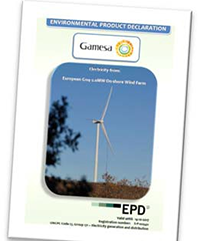 Environmental Product Declaration (EPD) of the G114 2 MW wind turbine
Gamesa has published a new Environmental Product Declaration (EPD), in this case of the G114 2 MW wind turbine model, as per the “International EPD System – Environdec”.
This document represents the certi?cation of the Environment Product Declaration (EPD), where the relevant environmental impacts are declared in relation to 1 Kwh of the electricity generated through a wind farm of Gamesa G114 – 2.0 MW wind turbines, which are in a European scenario and operating under medium wind conditions (IEC IIA) and distributed to a European consumer.
Due to the relevance of the “tower” component within the ?nal environmental results, an sensitivity analysis including a variation of this component was performed. The baseline scenario includes an 80-m high tower, while the alternative scenario was calculated using a 93-metre high tower.
“Life Cycle Costing” practical application in an Electric Vehicle Charging Station
 Life Cycle Costing-LCC is the analysis of all the costs that can be allocated to a product/service from the start of the development of the idea to the end of its serviceable life, by or for any stakeholder associated to the phases of the life of the product/service.
Life cycle costing allows the total cost of the product during its full life cycle to be established and which is assumed by the di?erent stakeholders: suppliers, manufacturer, distributors, users and waste managers, which is the baseline to identify and assess the opportunities for improvement in order to reduce the total cost. Furthermore, it is fully compatible with the Lifecycle Assessment (LCA) based on the product environmental assessment.
To advance further in Life Cycle Costing concepts, the Basque Ecodesign Center is developing a methodology guide in which Gamesa is participating with the practical application in one of its ecodesigned products, in this case, the Electric Vehicle Charging Station.
Gamesa publishes the Environmental Product Declaration (EPD) of its new 5.0 MW wind turbines
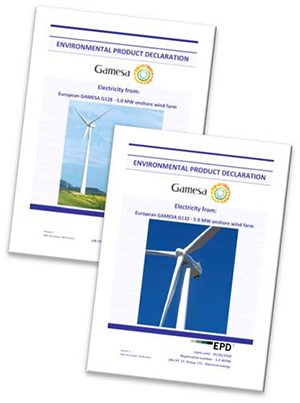 Gamesa has published two new Environmental Product Declarations (EPD) for its 5.0 MW models, as per the “International EPD System – Environdec”.
The 5.0 MW platform shows that Gamesa has the knowledge, experience and resources required to develop wind turbines capable of extracting the optimum energy possible.
The innovative modular design and the advanced technology of the Gamesa 5.0 MW platform means that maximum reliability can be ensured, along with complying the most demanding network codes and the most restrictive environmental standards.
Speci?cally, the models covered by these new EPDs are the G128 and the G132, which join the existing ones for the G90 and G114 equipment.
The EPD or Type III eco-labelling obtained is another example of the Gamesa transparency in the environmental declaration of the products and sustainability of its business.