
Design evaluation for end-of-life as foundation to establish implementation incentives
Design evaluation for end-of-life as foundation to establish implementation incentives
Current policies on waste management advocate for the prevention at source as the most efficient measure to reduce the waste generated by our society. Also, these policies aim to include all actors involved in the manufacturing and distribution of products, in the task of reducing waste generation and facilitate recycling.
In the last years, specific regulations have been approved in Europe for the different waste groups: disused tires, electrical and electronic appliance waste, batteries and accumulators, used oils, etc. Depending on whose responsibility is to manage the product end-of-life, there are two types of responsibilities for the producer:
- Collective producer responsibility. The waste management costs are assigned collectively, for example, based on the market share, and it is the system used currently for many waste types.
- Individual producer responsibility. The manufacturers are responsible for their own products at the end of their life. This does not mean that each producer has to create individual collection systems, but can use collective collection channels. The difference is the financing mechanism.
Criticism of this collective responsibility system focuses on the fact that they do not encourage product design improvements to improve its end-of-life management, as the resulting benefits are distributed among all the producers and do not reward producers that have introduced improvements.
To offer an alternative point of view to this problem, the Basque Ecodesign Center, in collaboration with Tecnalia, has initiated a methodological project focused on looking for new mechanisms that allow, in case a product has been designed to reduce its end-of-life impact thus reducing the management costs, this cost reduction affects the manufacturer who invested in improving the design of the product's end-of-life, generating a return on investment. The project is expected to be finalised in 2014.
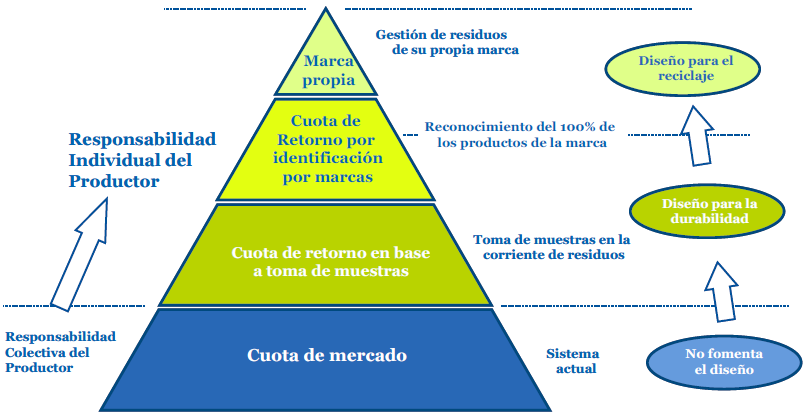
Etapas previstas para la evolución de un sistema colectivo a uno individual. Fuente: iprworks.org