European Pilot on “Environmental Product Footprint and Organisation”
European Pilot on “Environmental Product Footprint and Organisation”
Currently, there are over 400 different environmental labels in Europe, with similar goals but not with the same requirements. While their goal is to convey accurate information about the environmental performance of products and/or services, the wide disparity creates a lot of confusion among consumers.
In general, these systems can be grouped into three levels:
- Markings associated with compliance with mandatory legal requirements, such as the CE mark or the green dot. They are typically the manufacturer's conformity self-declarations ensuring compliance with certain environmental laws.
- Environmental assessment and comparison tools, such as energy performance certificate or carbon footprints. Its purpose is to allow comparison between different products, all tested under the same evaluation system.
- Best in class recognition systems, such as the European Ecolabel. These systems are an award that recognises those products carrying it as the best from the environmental point of view, within the category they belong to.
In the evolution that these three groups of systems had in recent years, one can detect the gradual integration of the principle of "life cycle thinking" or Life Cycle thought. Thus, there has been an evolution from a single vector thought (eg., the problems associated with the product end-of-life waste directives), which only took into account one aspect, to a multiple vector vision throughout the entire life cycle, and which takes into account the main significant environmental aspects, regardless of the stage of the life cycle where they occur (eg., the directive approach on energy-related products).
The following figure shows the evolution between these product environmental information systems.
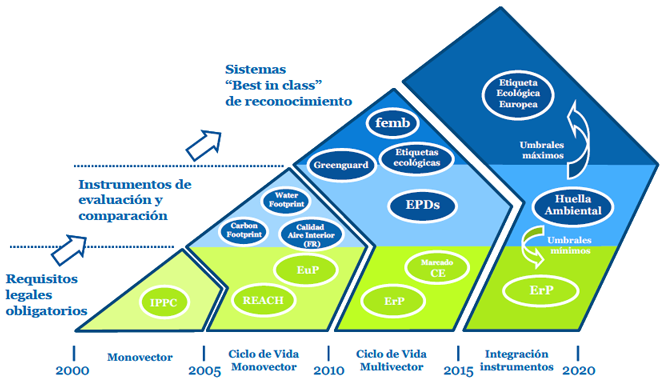
Chart of the different instruments of environmental information on products.
To try to solve the problems associated with this great system dispersion and associated labels, the European Commission, through the Directorate General for the Environment, has launched a project to define a new information standard that will replace all the existing ones from 2020.
This new project, called Product Environmental Footprint and Organisation, was officially launched on 21st October 2013 in Brussels.
By agreement with the Ministry of the Environment of the Spanish Government, the Basque Government's Environmental Management and Territorial Policy Company, Ihobe, will be the official representative in the working group set up to oversee the project, involving all countries of the European Union, the European Commission technical team, NGOs and business associations.