
Iberdrola
 Ecodesign of an electrical substationtransformer
This project aimed to obtain an environmental diagnosis of the Ordizia Transformer and Distribution Substation (Gipuzkoa), in order to explore the possibility of applying ecodesign criteria to the designs of plants in the electrical sector. One of the strong points of the project was the close collaboration between the team in charge of carrying out this analysis and the suppliers, who worked alongside each other throughout the project, supplying information and carrying out their own individual projects, which encompassed life-cycle assessments and ecodesign analyses of their equipment.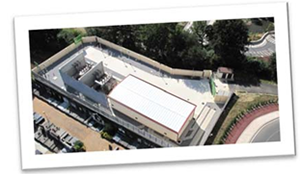
Una vez llevada a cabo la evaluación del impacto ambiental, se ha determinado que los mayores impactos en la STR Ordizia se concentran en la fase de uso de la instalación por el consumo de energía de los equipos que se producen durante los 40 años de funcionamiento de la instalación. En cuanto a los materiales con mayor impacto ambiental, es destacable el uso de placas electrónicas, seguido del gas aislante SF6. Los metales (latón, cobre, aluminio o aleación de ferroníquel) presentan también impactos destacables, en comparación con el resto de los materiales empleados en el análisis.
In terms of the materials with the greatest environmental impact, the use of circuit boards, followed by SF6 (Sulphur Hexa?uoride) insulating gas, were identi?ed as being particularly harmful.
Metals (brass, copper, aluminium and ferronickel alloy) also impact signi?cantly on the environment, in comparison with the other materials that were analysed. Thanks to this project, the ?rm will be able to devise strategies for improving the environmental.- Improving the energy e?ciency of the equipment and the station.
- Choosing more e?cient, ecodesigned equipment.
- Reducing the amount of materials used at the station.
- Replacing certain materials with others which generate a lesser environmental impact.
Biovalora: Evaluation of ecosystem services in a hydroelectric dam
The Biovalora project analysed how a hydroelectric dam modi?es ecosystem services, and the impacts and opportunities it generates with regards the environment, while also assessing the dam’s economic value in real terms. The project focused on the Cuenca del Tera dams in Zamora and, in addition to studying energy production, looked at the possible e?ects of the dams on biodiversity, tourism, agriculture, ?oods, ?res and water supply.
Results of the project:
- The water that is collected allows for the existence of a constant environmental ?ow, crop-watering and a supply of drinking water for more than 30,000 people.
- The dams manage to nullify half of the ?oods caused by torrential rainfall, and they mitigate the e?ects of other ?oods by more than 30%, which translates into an important ?nancial saving in avoided losses and damage.
Calculating the Environmental Index of the operations of an electricity company
Iberdrola has developed the “Environmental Performance Index”, an aggregated index of the environmental performance of all its operations in order to be able to numerically quantify the environmental impact of the operations of an electricity company.
As shown in the ?gure below, 18 environmental impact indicators have been taken into account and which have been subsequently grouped into three damage model indicators: in terms of human health, resource depletion and ecosystems. In accordance with the internationally validated RECIPE methodology, this has allowed the environmental performance of the organisation to be uni?ed in a single indicator.
The methodological documents existing both a European and global level for organisational Life Cycle Assessment have been followed to carry out this exercise.
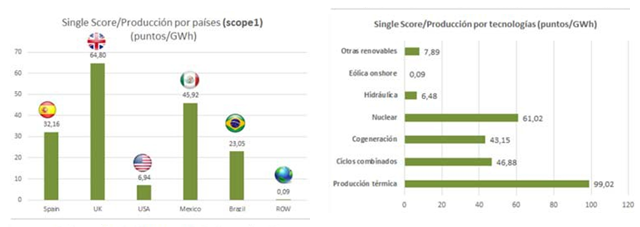
Resultado de la Huella Ambiental Corporativa de Iberdrola en 2014.
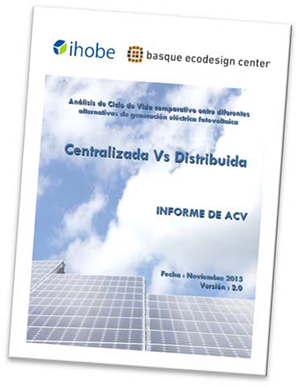 Comparative Life Cycle Assessment (LCA) study of the different photovoltaic solar generation technologies:
The main aim of the study consisted of measuring the magnitude of the environmental impacts arising from energy generation through di?erent photovoltaic technologies, from a full life cycle perspective. It also sought to assess the main di?erence that exist between di?erent situations of distributed photovoltaic generation and centralised photovoltaic generation, with the aim of establishing the environmental sensitivity of each of the variables involved in a generation system of this type. The goal was therefore to provide a global perspective of all the environmental impacts associated to the life cycle of a photovoltaic facility, providing useful information for future decision taking.
In order to achieve this objective, the full life cycle of 246 di?erent photovoltaic facilities was assessed, with the emphasis on establishing how the environmental impact of the energy generated in those complexes varied in order to modify their characteristic variables.