
Life Cycle Costing (LCC): Costing applied to the sustainable design of products and/or services
Life Cycle Costing (LCC): Costing applied to the sustainable design of products and/or services
Due to intensive consumption, the availability of some raw materials has become an economic and political concern both for governments and for companies. The precious and scarce materials are essential for many of the products that we use every day.
This challenge requires the design phase to consider both reusing and repairing products, by giving them a second or third life, and recycling and investing in commercially viable technologies that allow all the materials to be recovered from the waste. This will allow us to advance towards a circular economic model in term of materials ?ows.
It is therefore necessary to go beyond the traditional approach, limited to the production centre, and use the life cycle concept. This involves thinking about the social, economic and environmental impacts of the product from the extraction and processing of the raw materials, followed by the manufacturing, distribution, use, maintenance and repair, to the recycling or ?nal elimination.
The Basque Government’s Ministry for the Environment and Territorial Policy seeks to raise awareness about the use of rigorous and integral information in decision-making and to help companies that wish to reduce the environmental impacts in the life cycle of their products while generating greater social and economic wellbeing. This document seeks to provide the companies, institutions and the consumer with the most e?cient tools to calculate life cycle costs and their relation with the environmental performance of the products and service, thus following the recommendations of the EU roadmap to a resource-e?cient Europe. It also includes a GAMESA case study in one of its product, an electric vehicle charging station.
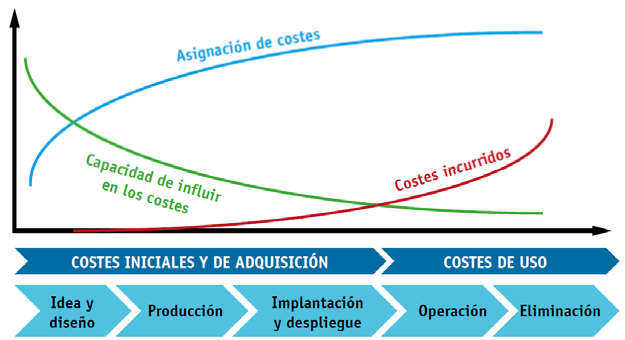
Produktu baten ingurumen-kostu eta –inpaktuen banaketa