ECODESIGN AND CIRCULAR ECONOMY: Product design strategies that favour the application of the Circular Economy
There are many definitions of what a circular economy is taken to mean in the literature. The Ellen MacArthur Foundation (2013, Towards the Circular Economy 1) defines the circular economy as a viable system that cap- tures value associated to the use of the products, instead of associated to the consumption of resources and energy. It therefore argues that the durability of the products and resources is fundamental. Basic principles of the circular economy are using non-toxic and natural resources, designing for disassembly and using rene- wable source energy.
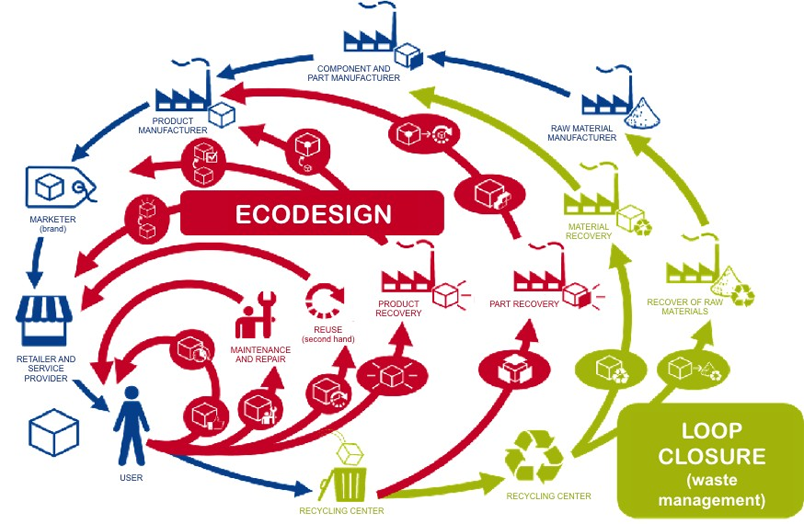
The principles of the circular economy are also applicable to product engineering. Ecodesign can be used to apply important strategies that facilitate the principles of the circular economy. To be able to delve further in this concept, the Ideas Laboratory of the Basque Ecodesign Centre got a technical working party tasked with researching this field up and running in 2015.
The working party identified five cores areas for action in Ecodesign to design products that contribute to the circular economy:- Diseño para la prolongación de la vida útil del producto
- Designing to extend the useful life of the product.
- Designing for maintenance and reparability.
- Designing for reuse.
- Designing to recover the product.
- Designing to recover parts.
These five core areas are deployed in turn in 11 strategies for action as shown in the following figure: