Work with the supply chain
For many years, supplier environmental traction has been related to a traction company care to guarantee the appropriate legal compliance as well as the implementation of basic aspects related to environmental management within the group of its supplier companies.
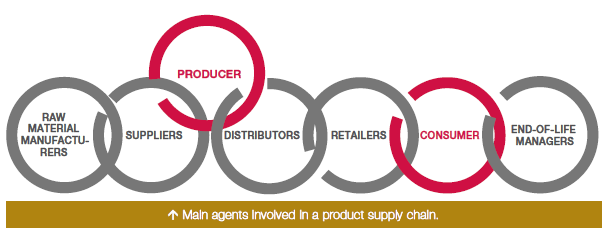
In the supply chain, the term "suppliers" normally refers to two "upstream" producer agents: raw material manufacturers and providers. This is why suppliers traction is only a small part of the supply chain traction therefore offering an incomplete vision. In short, in the supply chain environmental traction in the context of extended product responsibility, you need to be mindful of all the actors involved, both "upstream" and "downstream" of the producer, which involves:
- Manufacturers of raw material which later are purchased and processed by the producer.
- Providers of all those components already manufactured which will be part of the products, as well as service providers.
- Distributors servicing the traction company.
- Final retailers and sales representatives of the products and/or services.
- The Customer-Consumer, underlying reason of the business model and essential part of the supply chains. The aim of the supply chain is to satisfy precisely the customer's needs. This can be an industrial client (what is called B2B, "Business to Business") or an individual client (what is called
B2C, "Business to Consumer"). - End-of-life managers, which brings together a large number of agents that are responsible for the final product management at the end of its useful life (collection companies, management companies, raw material recycling companies, Integrated Management Systems (IMS), etc.).
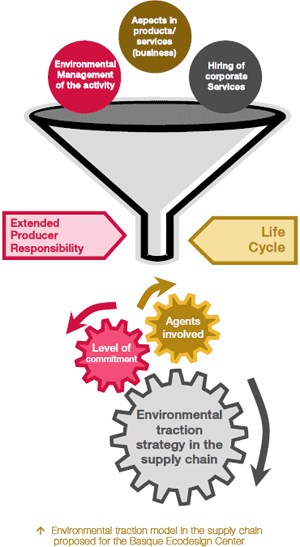
However, the approach presented in this document goes further and tries to show the traction, not only of the suppliers but also of the entire supply chain, and not focused exclusively on the general aspects of running a business, but in all elements involved in the environmental considerations of trade and business agreements, divided into three action areas:
- The environmental management of the activity, related to compliance with environmental legislation and implementation of environmental management systems.
- The environmental issues relating to the products and/or services of the company's business, applying the Life Cycle principle from design to the end-of-life management of the products or services of the traction company.
- The purchase and procurement of corporative supplies and services, those services and supplies not related to the products and services sold by the traction company, but which support normal operation.
To do this, a progressive system of steps to follow in order to reach an environmental traction strategy in the supply chain is proposed. On the way to this strategy, we will discuss two complementary aspects:
- The identification of the stakeholder agents and the relationships between them throughout the supply chain.
- The level of commitment in the traction to be obtained with each of these agents, based on a 3 levels of action model and 6 deployment strategies.
The whole process is defined according to two basic action principles, such as extended producer responsibility and consideration of the entire life cycle of the company's business.
Finally, to try to illustrate how this supply chain environmental traction can be carried out, the document details the possible implementation stages in each of the three action areas identified, explaining the resources available for each of them as well as examples and case studies of application performed by member companies of the Basque Ecodesign Center.